Pencil, as the most convenient tool for writing and painting, can be seen almost everywhere in our life. I believe that most people's writing enlightenment starts from using pencils! And how much do you know about this little thing that is often overlooked in life? Let's talk about "pencil".
Development & origin
In 1564, a black mineral graphite was found in Barodale, England. At that time, people did not know the composition of graphite, so they called graphite "black lead", which is the origin of the name of pencil.
Local herdsmen found that they could use graphite to mark the sheep. Inspired by this, people cut graphite blocks into small strips for writing and painting. However, the graphite strips are easy to get dirty and break.
In 1761, German chemist Faber mixed sulfur, antimony, rosin and other substances into the purified graphite powder and pressed it into the shape of a pen, which was the earliest prototype of a pencil. But in fact, the pencil is just lead.
In 1812, American William Monroe put a wooden tube on the pencil lead to make the earliest prototype of today's pencil. Later, he installed an eraser on the head of the pencil, which is still used today.
Pencil hardness
The pencil lead we use today is made of graphite and clay in a certain proportion. Because the graphite is soft and slippery, it is only used as the pencil lead, which is easy to break and wear. Therefore, some clay powder is added into the graphite powder to increase the hardness of the pen core. The more clay is mixed, the harder the pencil is; the less clay is mixed, the softer the pencil is.
Generally, "H" represents a hard pencil, "B" represents a soft pencil, "HB" represents a pencil with moderate hardness, and "F" represents a pencil with hardness between HB and H.
Pencil hardness grade: 9B, 8B, 7B, 6B, 5B, 4B, 3B, 2B, B, HB, F, H, 2H, 3H, 4H, 5H, 6H, 7H, 8H, 9H, 10H from soft to hard.
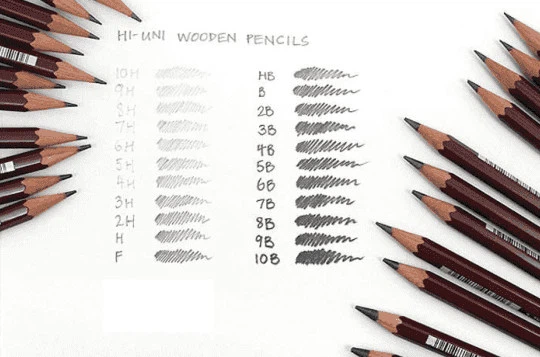
The larger the number in front of H, the harder its lead core is, and the lighter its color is. The larger the number in front of B, the softer the lead core, the darker the color.
Class H pencil has a relatively high core hardness, which is suitable for objects with relatively hard or clear interfaces, such as carpentry scribing, field drawing, etc;
The HB pencil core has moderate hardness, which is suitable for writing or outlining under normal circumstances;
Class B pencil, with relatively soft lead, is suitable for painting, and can also be used to fill in cards that can be recognized by machines.