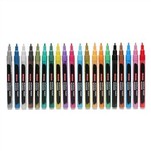
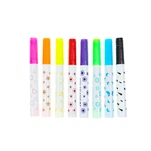
1. Choose the appropriate marker pen
- Select the type according to the purpose
If it is used for painting creation, such as illustration, a double-ended marker pen can be chosen. One end of it is thin and can be used to draw detailed lines, such as the facial features of characters and the Windows of buildings. The other end is thick, suitable for large-scale coloring, such as quickly filling colors into areas like clothes and backgrounds.
For marking or daily writing, such as highlighting key points on documents or making labels, a regular single-ended marker pen is sufficient. This type of marker pen has a moderately hard tip, writes smoothly, has bright colors and is easy to identify.
- Consider the characteristics of the pigment
The pigment of the alcohol-based marker pen is alcohol-based solvent-based. Its advantages include bright colors, strong covering power, and the ability to mix and gradient colors. However, its smell is rather strong. It is best to use it in a well-ventilated environment. For example, when it is necessary to draw a landscape painting with rich color gradations, such as the gradual change of the sky from light blue to dark blue, an alcohol marker pen can accomplish this task very well.
Water-based markers have soft colors, are relatively environmentally friendly, have a low odor, and are suitable for children to use. However, its covering power is relatively weak and it is easily stained by water. If you are teaching students about painting at school, water-based markers are a relatively safe choice.
2. Brushstroke techniques
- Line drawing
When drawing a straight line, keep your wrist stable. You can tilt the marker at a certain Angle to ensure that the tip of the pen makes full contact with the paper surface. If you need to draw lines with varying thicknesses, you can achieve this by adjusting the Angle between the pen tip and the paper surface. For instance, when drawing the hair of a comic character, use the thin tip of a marker pen. By changing the Angle of the pen tip, draw lines from thick to thin from the hair root to the tip, enhancing the three-dimensional effect of the hair.
For curves, it is necessary to maintain a uniform speed and make the lines smooth and natural. You can first gently outline the general shape of the curve with a pencil, and then draw along the pencil line with a marker pen. For example, when drawing the outline of an animal's body, the curves of the animal's body are rather complex. First, use a pencil as the base, and then draw with a marker pen, which can ensure the accuracy of the lines.
- Fill color
When filling large areas of color, apply it in a certain direction, such as from left to right or from top to bottom. This can make the color more even. If you find any areas with uneven color, you can wait until the first coat of color is completely dry before applying the second coat. For example, when filling in the color of a cartoon character's skirt, apply pink from top to bottom. After the first coat of color is completely dry, apply it in the lighter areas to make the skirt's color full and even.
For filling areas with textures or patterns, different brushstrokes can be used to express them. For instance, when drawing a desktop with wood grain, you can use a fine tip of a marker pen to imitate the direction of the wood grain and fill it in with short lines to present the texture effect of the wood grain.
3. Color Matching and Gradients
- Color matching
The color wheel can be used to help select the matching colors. Adjacent colors (such as yellow and green) combined together will be more harmonious, giving people a natural and comfortable feeling. Complementary colors (such as red and green) combined will create a strong contrast effect, which can highlight the key points of the picture. For example, when painting a landscape of spring, yellow and green can be used to represent the grassland and leaves, creating a vibrant atmosphere of spring. If you want to highlight the flowers in the picture, you can use red flowers and green leaves for contrast and combination.
Consider the overall tone of the picture. If it is a warm-toned picture, such as a beach under the setting sun, warm-toned markers like orange and yellow can be chosen to draw the sky, the beach and the sea water. If it is a cold-toned scene, such as a snow scene in winter, the main colors should be blue, white and other cool tones.
- Gradient effect
For alcohol markers, a gradient can be achieved by superimposing colors. First, apply a base color with a light-colored marker. When the color is slightly dry, start applying a dark marker at one end of the light-colored area, allowing the dark and light colors to blend naturally. For example, when drawing the sky, first apply a layer of light blue, and then apply dark blue above the sky to create a gradient effect of the sky from light to dark.
If it is a water-based marker pen, a small amount of water can be dropped between the colors to help the colors spread and achieve a gradient. However, it is necessary to control the amount of water to avoid excessive color blurring.
4. Maintain markers
After use, the pen cap should be covered in time to prevent the pen core from drying out. If you find that the pen core has dried out, for alcohol-based markers, you can try using a special cleaner or refilling the ink to restore the moisture of the pen core. For water-based markers, you can soak the pen tip in water for a while, but this method is not very effective. If the pen core has completely dried out, it may be necessary to replace it with a new one.
Avoid placing the marker pen in high-temperature, humid or direct sunlight areas, as these environments can affect the quality of the pen core and the stability of the pigment.